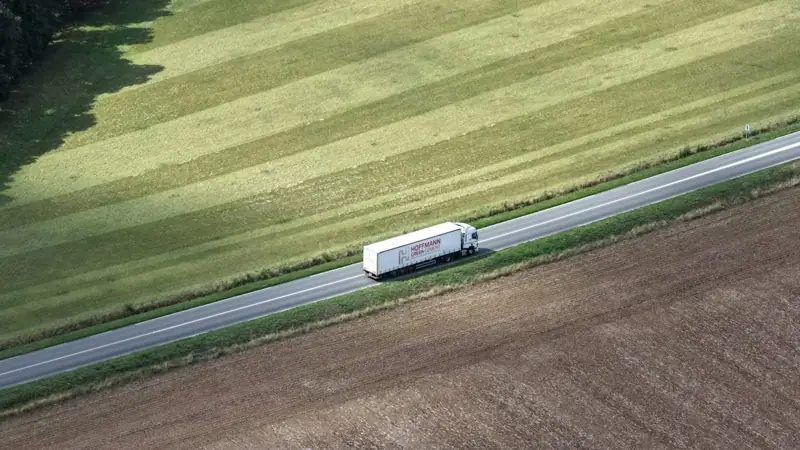
"Dedicated" is on a lot of CDL-A job ads. It sounds good, but it does not tell you much on its own. Here is what it really means, and what to ask before you take one.
What "dedicated" means
A dedicated account is a contract between a carrier and one customer: a retailer's distribution center, a grocery chain, a manufacturer, a beverage or building-supply company. The carrier sets aside trucks and drivers that haul only for that customer.
You still work for the carrier. The carrier pays you and dispatches you. On many accounts, though, the dispatcher sits at the customer's facility, and your day is built around the customer's schedule.
Dedicated is not one kind of schedule. It can be:
- Local: store deliveries out of a distribution center, home every day.
- Regional: runs between plants, warehouses and stores in a few states, home weekly or several nights a week.
- Longer runs: one shipper's freight across more of the country, out a week or more at a time.
Dedicated vs. OTR vs. local
| Dedicated | OTR | Local | |
|---|---|---|---|
| Who you haul for | One customer | Many customers | Several customers in one area |
| Lanes | Same lanes, same docks | Changes every load | Short radius around the yard |
| Home time | Depends on the account | Usually 2 to 3 weeks out | Usually daily |
| Typical pay | Per mile, hourly, per stop or activity pay | Mostly per mile | Hourly or by load |
What our numbers show
Right now we have 164 dedicated CDL-A jobs in our database. The median carrier-reported weekly pay on those jobs is about $1,400. For comparison, OTR jobs come in around $1,200 and local jobs around $1,550. These are averages that carriers report, not promises, and they update every time our job list updates. Use them to see where a single offer sits, not to predict your own check.
Why drivers like dedicated
- Predictable work. Same roads, same docks, often the same people. You learn where to park, which door to use and how long the unload takes.
- Steadier freight. Contract freight for one big customer usually keeps moving when the spot market slows down.
- Planned home time. Because the customer's schedule repeats, home time is often easier to plan than on OTR.
- Some of the easiest freight. Many runs between distribution centers and plants are drop and hook or no-touch.
The downsides
- Touch freight. Many store-delivery accounts mean unloading with a pallet jack, rollers or a liftgate, sometimes at several stops a day.
- Fixed start times. Often very early in the morning or overnight, and not easy to change.
- A tight hiring area. You usually have to live within a set distance of the yard or distribution center.
- The account can change. If the customer moves its business, the carrier may move you to another account, and the job may look different.
- Less variety. If you like seeing new places, the same lanes every week can get old.
How dedicated jobs pay
There is no single pay style. You may see:
- Per mile, often with stop pay on top.
- Hourly, common on local accounts, with overtime on long weeks.
- Activity or stop pay, where you are paid per stop, per delivery or per piece of work.
- A weekly minimum, on some accounts, for weeks when the work runs short.
Do not compare a dedicated offer by one number. Ask for the average weekly pay of drivers on that account over the last few months, not the best week of the best driver. Our article on comparing jobs beyond cents per mile shows how.
10 questions to ask about any dedicated job
- What kind of customer is it: retail, grocery, manufacturing, something else?
- How long has the carrier had this account?
- Where is the yard or distribution center, and how far from it can I live?
- What are the start times and days, and are they the same every week?
- Is it touch freight? How much, and with what equipment?
- How many stops a day, on average?
- How is pay calculated: per mile, hourly, per stop, or a mix?
- What do drivers on this account average per week over the last few months?
- How many nights a week am I home, exactly? (See what home time really means.)
- What happens to my job if the account ends?
Good dedicated job, bad dedicated job
A good one has clear answers: a stated average weekly pay, a real hiring area, the touch freight and stops spelled out, and a schedule you can repeat.
A weak one stays vague. Watch for "dedicated" on a job that turns out to be random freight, home time described as "regular" or "frequent" without a number, or pay quoted only as "up to".
How we list dedicated jobs
On every dedicated job page we show what the carrier reports: the hiring area, home time, freight and how it unloads, pay as an average or a range, and the experience required. Browse our dedicated CDL-A jobs, or put in your ZIP and we will match you with the ones you can actually get.
Want a recruiter who answers these questions before you ask?
Tell us 4 things and we match you with CDL-A jobs you can actually get. The carrier pays us when you are hired, you never pay us.